The Compliance Health Check Your Business Needs Every Month: Statutory Dues Verification
If you're a founder or CFO, here's a question worth sitting with: when was the last time someone actually verified that your TDS, EPF, ESIC, and Profession Tax payments matched what your books said they should?
For most SMEs, the honest answer is "during the audit." Which is too late.
A missed TDS deadline triggers interest and late fees. A mismatched PF contribution shows up as a red flag in Clause 20 of Form 3CD. An ESIC underpayment can attract damages of up to 25% per annum. And a Profession Tax oversight, however small, becomes a compliance scar that follows your business.
This is why every month at K P N R & Co. / VirtualCA, we run a Statutory Dues Verification for our clients — a structured compliance health check that catches issues before they become assessments.
Here's the framework we use.
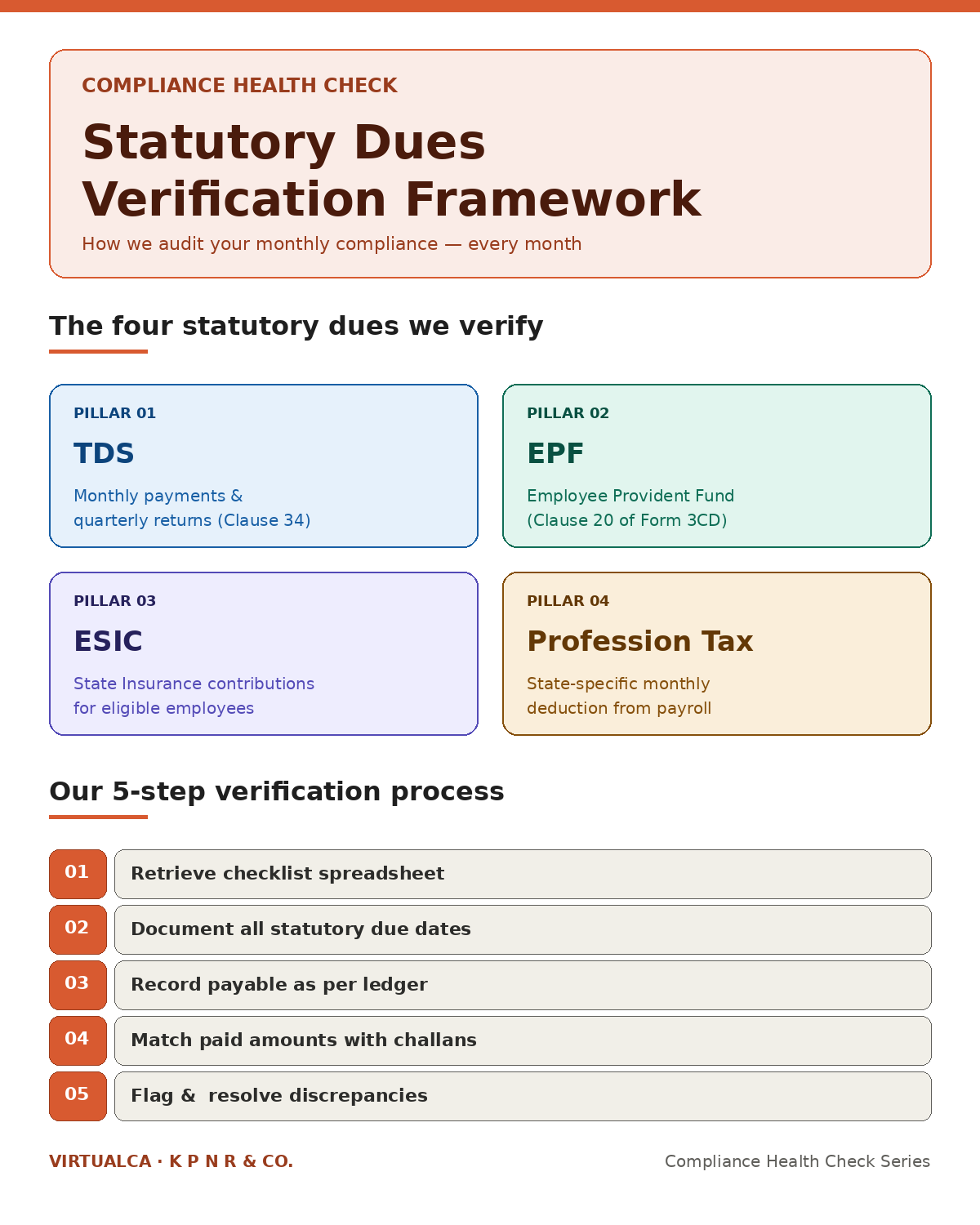
The Four Statutory Deductions Every Business Must Track
For most companies, these four statutory dues form the monthly compliance backbone:
1. TDS (Tax Deducted at Source) — Monthly deposits with quarterly return filings (Form 24Q, 26Q, 27Q). Errors here cascade into Form 16/16A mismatches for your employees and vendors.
2. EPF (Employee Provident Fund) — Monthly contributions for eligible employees. Reported under Clause 20 of Form 3CD during tax audit.
3. ESIC (Employees' State Insurance Corporation) — Applicable to employees earning up to ₹21,000/month. Also reported under Clause 20.
4. Profession Tax — State-specific levy deducted from salaries. Telangana, Karnataka, Maharashtra, and West Bengal all have their own slab structures and due dates.
Each has its own monthly due date. Each has its own payment portal. Each has its own consequences for delay. Which is exactly why a centralised verification process matters.
Why Centralising This Data Is a Game-Changer
When we consolidate statutory dues data for a client, it unlocks six immediate benefits:
- Single source of truth for due dates vs. payment dates — no more missed deadlines because someone was on leave
- Clause 20 of Form 3CD (PF and ESI reporting) becomes a copy-paste exercise instead of a scramble
- Clause 34 (TDS returns) is populated with documented filing dates and nature of expense
- Payroll-to-PF/ESI reconciliation — the contribution amounts in your payroll sheet must match what was actually deposited
- TDS-to-payroll matching — every salary above the threshold should have the correct TDS deducted
- Profession Tax coverage check — every eligible employee in payroll should have PT deducted
This isn't audit-time housekeeping. It's a monthly discipline that pays dividends three times over: cleaner books, faster audit, zero compliance surprises.
Our 5-Step Verification Process
Here's exactly how we run a statutory dues check for a client:
Step 1: Retrieve the checklist spreadsheet from our Checklists directory. Standardised template, same fields every month — consistency is half the battle.
Step 2: Document all statutory due dates for the month. TDS by the 7th. PF by the 15th. ESIC by the 15th. PT as per state.
Step 3: Record the payable amount as reflected in the client's ledger books. This is what should have been paid.
Step 4: Note down the actual paid amounts along with payment dates from the challans. This is what was paid.
Step 5: Reconcile and resolve. Any gap between Step 3 and Step 4 — whether amount, date, or category — is flagged and discussed with the client immediately.
What Gets Caught by This Process
In our experience running this every month, the most common red flags are:
- TDS deducted at the wrong section code (94C vs. 94J, for instance)
- PF contributions paid for employees who've already exited
- ESIC contributions missed for newly-hired employees in the ₹21,000 bracket
- Profession Tax not applied for branch employees in another state
- A challan paid but not entered in the books (or vice versa)
Each one is small in isolation. Cumulatively, they're the difference between a clean audit and a long list of qualifications.
Should You Be Doing This?
Yes, if your business has:
- Payroll of more than 10 employees
- Any vendor payments attracting TDS (rent, professional fees, contractor payments)
- Operations across multiple states
- Any plan to raise funding, sell stake, or attract investors in the next 24 months
Investors, banks, and acquirers will ask for statutory compliance certificates. The cleaner your monthly trail, the simpler that conversation becomes.
How VirtualCA Can Help
We run monthly Statutory Dues Verification as part of our Compliance Health Check service for SME clients across Hyderabad and beyond. You get:
- A structured monthly compliance dashboard
- Discrepancy alerts within 7 days of month-end
- Direct coordination with your payroll and accounts team
- Audit-ready Clause 20 and Clause 34 documentation
Want a compliance health check for your business? Reach out — we'll do a one-time review of your last quarter's statutory payments at no cost, so you know exactly where you stand.
📍 VirtualCA
Hi-Tech City, Hyderabad
Disclaimer: This post outlines general compliance practices for statutory deductions in India. Specific due dates, rates, and applicability vary by state, industry, and employee count. Always consult a qualified Chartered Accountant for advice tailored to your situation.

Comments