
Cloud Accounting vs Traditional Accounting: What's Actually Right for an Indian SME
Technology has been quietly reshaping how we run our businesses, and accounting is no exception. The choice in front of every Indian startup and SME today is pretty clear: stick with a traditional desktop setup — a copy of Tally on the office computer, spreadsheets, and printed registers — or move to cloud accounting, where the software lives on the internet and your numbers move with you.
The honest answer most CAs will give you in 2026 is that cloud accounting isn't just a nice-to-have anymore — it has become the smarter choice for nearly every growing business. Here's why, walked through the way we look at it at VirtualCA: costs, scalability, efficiency, reporting, accessibility, and the one factor that matters more in India than almost anywhere else — GST compliance.
Costs: predictable subscription vs heavy upfront spend
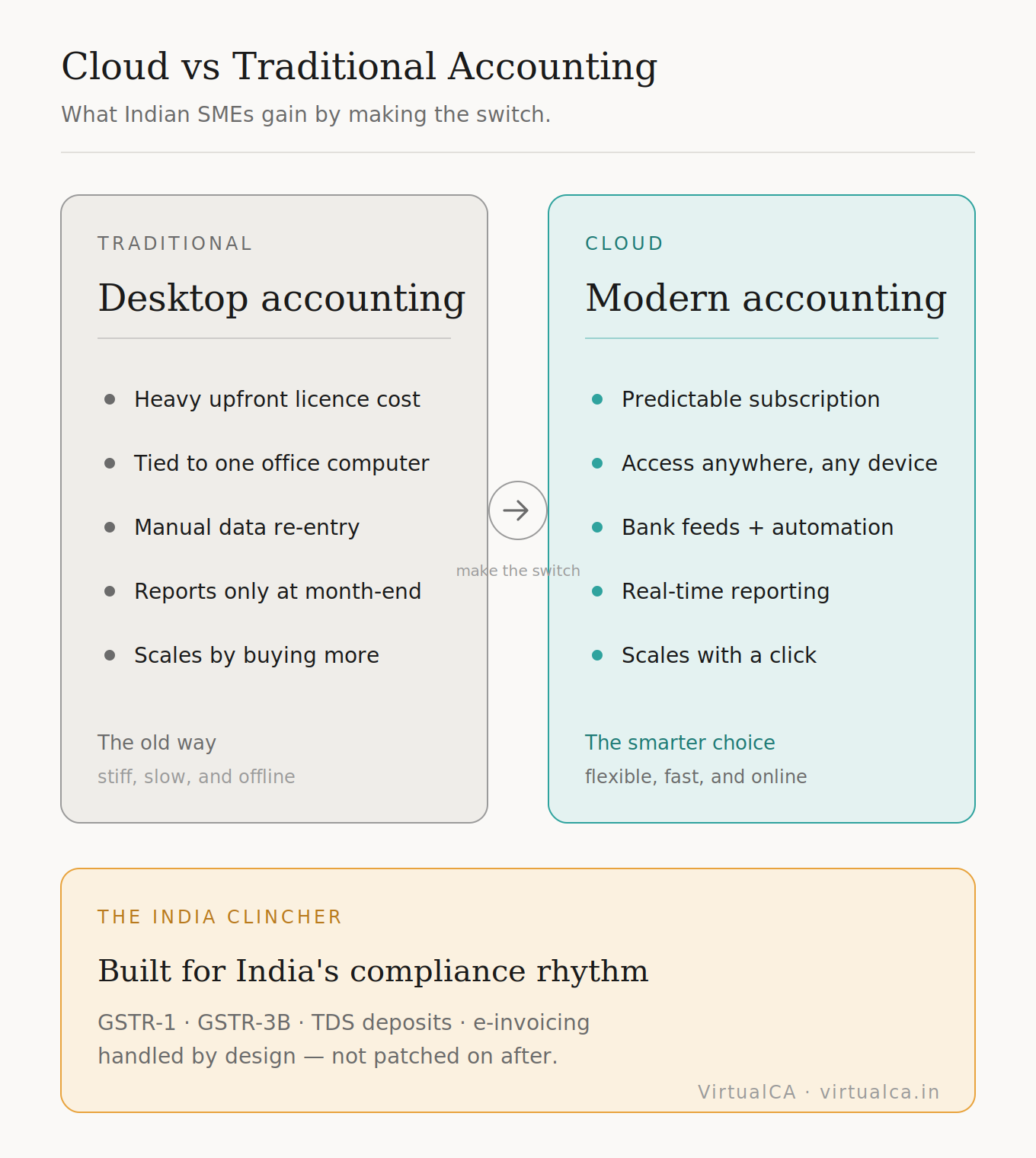
Traditional accounting starts with a noticeable upfront hit — a perpetual software licence per user, a decent computer or local server, installation and setup, and an annual maintenance contract on top. Every time a major version rolls out, that's another cheque to cut.
Cloud accounting works on a subscription model — typically a fixed monthly or annual fee that covers features, security, updates, and support, with no hardware to maintain. For a startup or growing SME watching every rupee of cash flow, that predictability is genuinely valuable. You spread the cost, you know exactly what you're paying, and you avoid the lumpy capital expense that traditional setups demand.
Scalability: grow without buying everything again
Every business worth running has ambitions to grow. The question is whether your accounting system can grow with you — or whether it becomes the bottleneck.
With cloud accounting, scaling up usually means clicking a button. Adding a new user when you hire? Done. Opening a second branch? Bring it onto the same platform. Need inventory or project modules? Toggle them on. And when seasonality drops or things slow down, you can scale back just as easily.
Traditional setups are stiffer. More users means buying more licences. More locations often means duplicating installations, juggling data files, and the inevitable WhatsApp message of "please send me the latest backup." It's expensive, slow, and disruptive — three things a growing business can't afford.
Efficiency: stop entering the same data three times
Ask any small-business owner if there are transactions someone in their company enters more than once across different tools, and the answer is almost always yes. That duplication is exactly where cloud accounting earns its keep.
Modern cloud tools like Zoho Books — or Tally hosted on the cloud — pull bank feeds directly from most major Indian banks, auto-generate GST-compliant invoices, track expenses in real time, and integrate with payroll, CRM, your website, and inventory tools. Once these systems talk to each other, the manual re-entry quietly disappears, mistakes drop, and your team's time shifts from data entry to actually understanding the numbers.
Traditional setups force you to juggle multiple platforms that don't speak to each other. Time leaks, errors creep in, and someone always ends up reconciling things at midnight before a deadline.
Real-time reporting: looking through the windscreen, not the rear-view mirror
This is where cloud accounting really comes into its own. Instead of waiting until month-end to see how the business is doing, you get live profit & loss views, cash-flow snapshots, customer-wise sales analysis, and segment performance — at any moment.
In a competitive market, speed and clarity of insight aren't optional. The point isn't to obsess over your numbers every hour; it's to be able to look at them whenever a decision demands it — pricing changes, hiring calls, a vendor negotiation — and act with information rather than gut.
Access from anywhere — on phone, tablet, or laptop
A cloud system isn't tied to one machine in one office. You can check yesterday's collections from your phone in a client meeting, approve a payment while travelling, or have your CA log in and review your books from a different city — no pen drives, no VPNs, no remote-desktop gymnastics.
Traditional accounting, by contrast, is anchored to the office computer where Tally is installed. Remote work means workarounds that are clunky at best and a security risk at worst.
The Indian clincher: GST, TDS, and e-invoicing
Here's the angle no overseas comparison really captures. India's compliance calendar is relentless — GSTR-1 by the 11th, GSTR-3B by the 20th, TDS deposits by the 7th, e-invoicing thresholds, e-way bills, ITC reconciliation against GSTR-2B. Doing all of this from a static desktop ledger means manually preparing every return, every time.
Cloud accounting platforms designed for India have all of this built in. Invoices are generated GST-ready with the correct HSN/SAC codes and your GSTIN. Returns can be prepared and pushed to the GSTN portal directly. ITC reconciliation against GSTR-2B happens with a click. The bookkeeping you do every week feeds your compliance with almost no extra effort — which is exactly what you want when penalties and blocked input credit are the cost of falling behind.
So what's the call?
Moving to cloud accounting isn't about chasing shiny technology — it's about making a smart, informed choice that protects your cash flow, your time, and your compliance. You get scalability without re-buying, efficiency without duplication, real-time insight instead of month-old numbers, access from anywhere, and a system that handles India's compliance rhythm by design.
For most Indian startups and SMEs today, sticking with a purely desktop setup is choosing to do business in 2026 with 2006 tools.
At VirtualCA, we help businesses make this transition cleanly — picking the right platform for your size and stage, migrating data without losing history, and setting up the workflows so your books, GST, TDS, and reporting all work as one connected system. If your current setup feels like it's slowing you down rather than helping you grow, that's usually the sign it's time to talk.
Comments