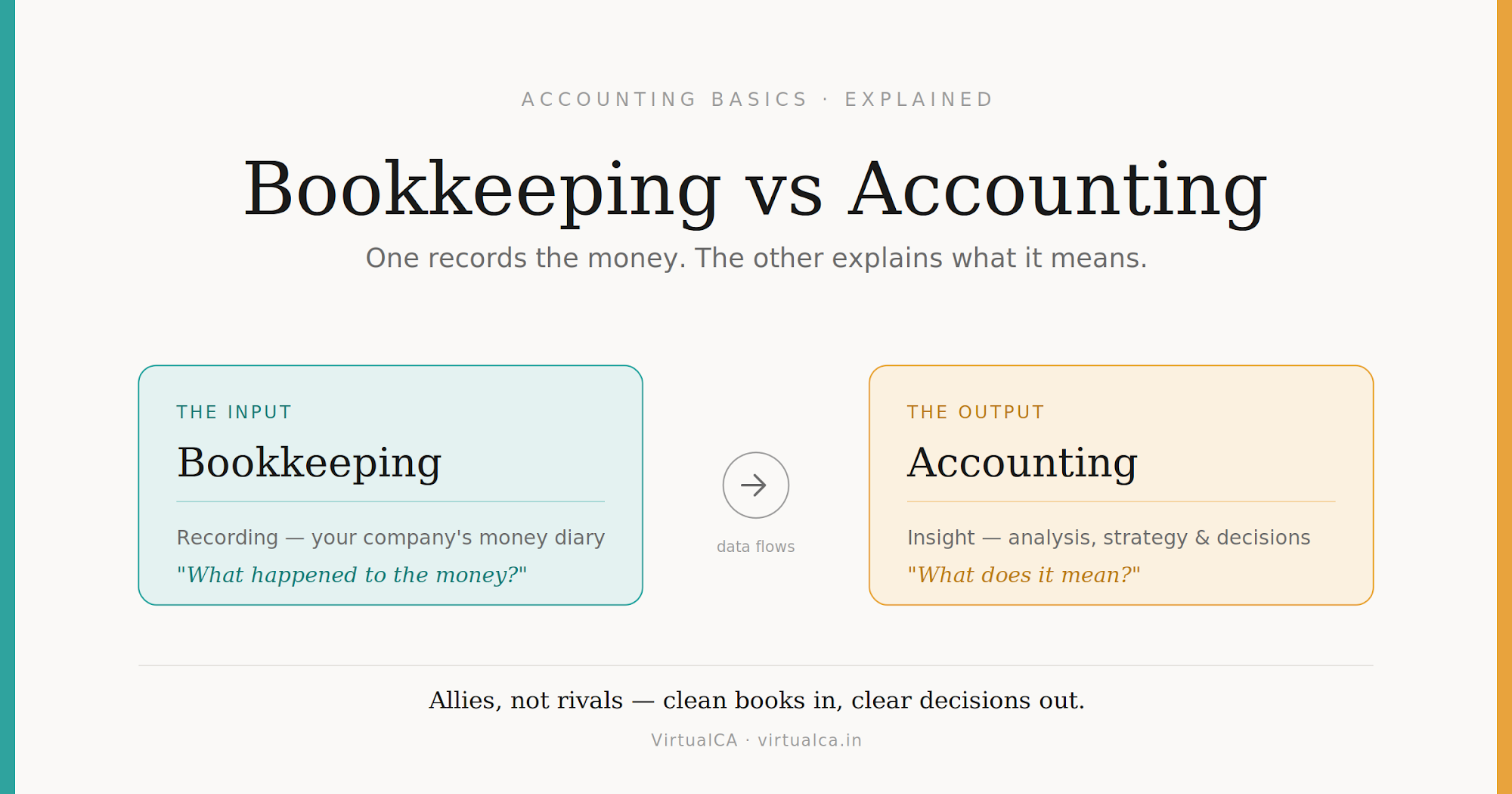
Bookkeeping vs Accounting: What's the Difference (And Why Your Business Needs Both)
If you've ever heard the words bookkeeping and accounting used as though they mean the same thing, you're not alone. They're closely related — but they are not identical. And confusing the two can quietly cost you time, money, or even land you in trouble at tax time.
Here's the surprising truth that sums it up: every accountant relies on good bookkeeping, but not every bookkeeper is an accountant. Let's clear up the confusion once and for all.
What is bookkeeping?
Bookkeeping is the foundation of everything. At its simplest, it's the practice of recording, processing, summarizing, and reporting your financial transactions. Think of it as your company's money diary — every time money comes in or goes out, it gets written down.
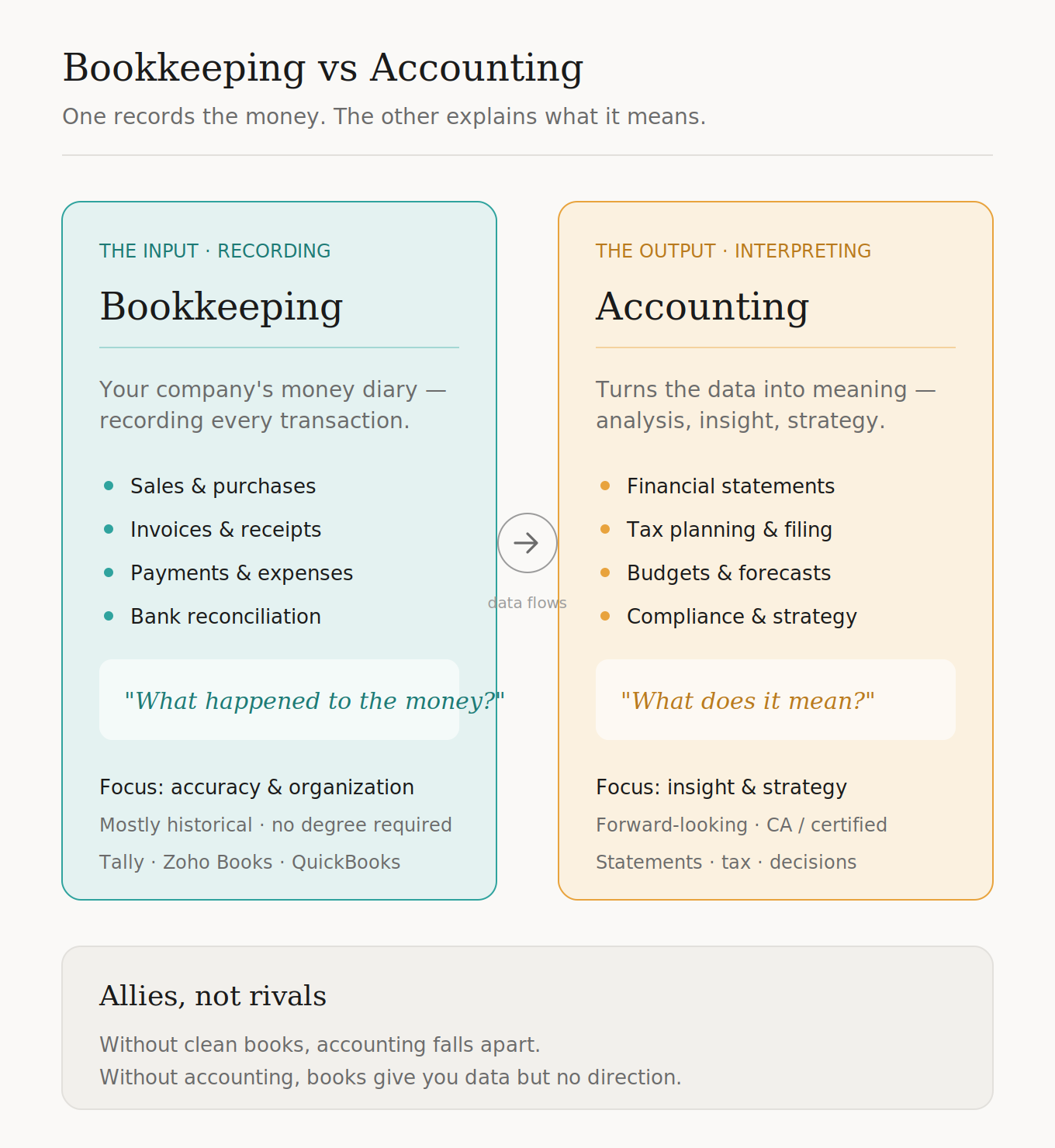
That includes sales, purchases, payments, receipts, invoices, and expenses. A good bookkeeper lives by two values: accuracy and organization. Their job is to make sure every single transaction is recorded correctly and consistently, so the numbers can always be trusted.
Most bookkeeping today runs on software — Tally, Zoho Books, QuickBooks, Xero, or Wave — but the goal is exactly what it has always been: clean, detailed, reliable financial records.
Crucially, bookkeeping is historical. It answers one question: what happened to the money?
What does a bookkeeper actually do?
The day-to-day work falls into four buckets:
- Recording — entering supplier bills and purchase orders into the accounting system, or feeding timesheets into payroll.
- Processing — paying supplier bills, running payroll, and reconciling bank transactions against the books.
- Summarizing — pulling raw data into reports, like a clean monthly payroll summary.
- Reporting — passing those summaries to management so they can make smart decisions.
This work matters far more than people assume. Owners and managers can't make good calls — Can we afford to hire? Should we spend on that marketing push? — without complete, accurate, up-to-date numbers in front of them. Timely bookkeeping is one of the genuine foundations of a healthy business.
How much of it you need depends entirely on size. A freelancer usually does their own. A small business — say, a salon or a boutique — might handle it in-house or bring in a part-time bookkeeper. A giant like a multinational employs dozens, each with a narrow role: payroll officers, accounts-payable clerks, bank-reconciliation clerks, and so on.
What is accounting, then?
Accounting picks up where bookkeeping leaves off. It takes the clean data the bookkeeper has created and analyzes, interprets, and summarizes it.
Accountants don't just record numbers — they use them to understand the financial health of the business and to guide decisions. They prepare your core financial statements (the income statement, balance sheet, and cash flow statement), handle tax planning and filing, build budgets and forecasts, run financial analysis, and ensure you stay compliant with the law.
Where bookkeeping is about accuracy, accounting is about insight, strategy, and compliance. It answers the bigger questions: Is the business actually profitable? Where can we cut costs? How much tax do we owe? Are we in a position to grow or invest?
In short, accounting turns numbers into meaning.
The clearest way to tell them apart
Think input versus output.
Bookkeeping is the input — raw financial data, entered correctly and consistently. Accounting is the output — the interpretation of that data to support real decisions.
There's also a difference in training and responsibility. Bookkeepers typically don't need advanced degrees. Accountants generally hold formal qualifications and certifications — in India, that means a Chartered Accountant — and carry broader legal and financial responsibility, including signing off on statutory compliance.
They're allies, not rivals
Here's the part most business owners miss: bookkeeping and accounting aren't competitors — they're partners.
Without good bookkeeping, accounting falls apart. If the underlying records are inaccurate or incomplete, even the sharpest accountant's analysis will be unreliable — garbage in, garbage out. And the reverse is just as true: bookkeeping without accounting leaves you with plenty of data but no direction.
That's why the journey usually looks like this. Early on, small businesses stick to solid bookkeeping. As they grow, they bring in accounting support for the strategy, tax, and compliance side. Larger companies run both functions side by side.
The bottom line
So here's the lesson, plain and simple: bookkeeping records the movement of your money; accounting explains what it means.
If you run a business, understanding this difference helps you know exactly who to hire, what services you actually need, and how to stay financially healthy — instead of paying for the wrong thing or, worse, flying blind.
At VirtualCA, we help startups and growing SMEs get both right — clean books underneath and sharp accounting on top — so your numbers stop being a mystery and start driving better decisions. If you're not sure which one your business needs right now, that's exactly the kind of question we're here to answer.

Comments