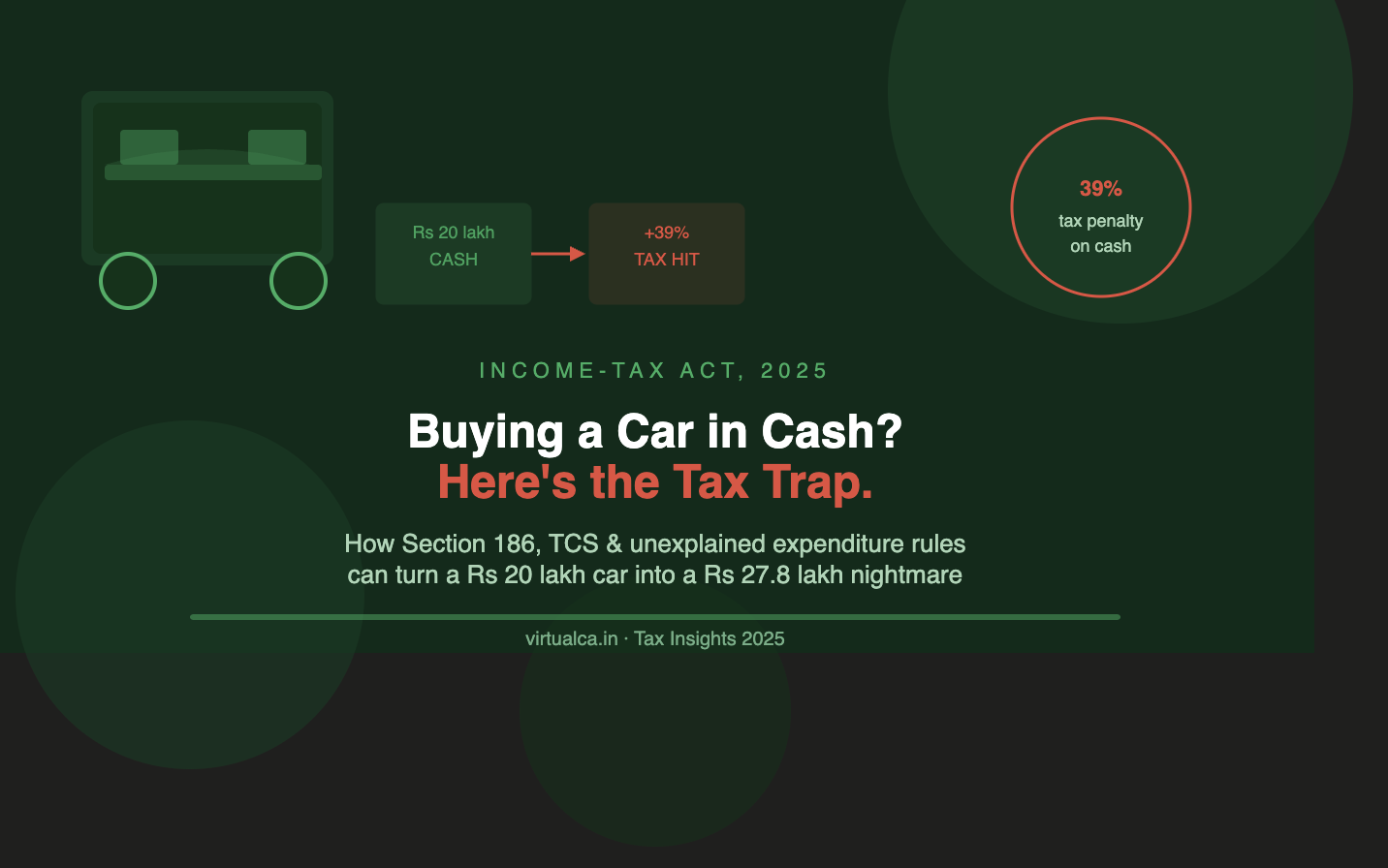
Buying a Car in Cash? Here's the Tax Trap Nobody Tells You About
Picture this. You've worked hard, saved diligently, and you're finally ready to buy that Rs 20 lakh SUV — in full, in cash. No loans. No EMIs. No bank hassle. Simple, right?
Wrong. Under the Income-Tax Act, 2025, that "simple" cash payment could end up costing you nearly Rs 7.8 lakh extra in taxes and penalties. Here's exactly how the taxman sees your suitcase full of cash — and why it's a trap you absolutely want to avoid.
Step 1: The dealer can't even legally accept it — Section 186
The very first problem hits before you even drive off the lot.
Section 186 of the Income-Tax Act, 2025 flatly prohibits anyone from receiving Rs 2 lakh or more in cash — in a single transaction, in a single day, or for a single event. The car dealer who accepts your Rs 20 lakh cash? They're inviting a penalty equal to 100% of the amount received — that's Rs 20 lakh gone, under Section 451.
And here's the part that stings for you: your name and the dealer's name are now permanently linked in a high-value tax violation file. The transaction is flagged before the ink on your RC even dries.
Step 2: The government already knows — TCS + SFT reporting
Even if somehow the cash changes hands, the system is built to catch it.
Under Section 394, the dealer is legally required to collect Tax Collected at Source (TCS) at 1% on any motor vehicle sale above Rs 10 lakh. For your Rs 20 lakh car, that's Rs 20,000 collected upfront — and it acts as a digital breadcrumb trail straight to your transaction.
But the bigger flag comes from Section 508. The motor vehicle registering authority is legally obligated to file a Statement of Financial Transaction (SFT) with the Income Tax Department for every high-value vehicle purchase. Your "private" cash deal is visible on the taxman's dashboard before you've even filled your first tank.
There is no hiding a cash car purchase in 2025. The system is designed, top to bottom, to surface it.
Step 3: The real blow — unexplained expenditure under Section 105
This is where things get truly painful.
If the Income Tax Department notices that you spent Rs 20 lakh on a car but can't find matching income in your returns, they classify it as Unexplained Expenditure under Section 105. The entire Rs 20 lakh gets added back to your income for that year — taxed as if you earned it but hid it.
And the tax rate under Section 195 on such unexplained amounts is not your normal slab rate. Under the Income-Tax Act, 2025 (as updated by the Finance Act, 2026), the base tax rate is 30%, with a 25% surcharge on top, plus 4% cess. That works out to an effective rate of approximately 39%.
The real numbers on your Rs 20 lakh car:
| Component | Amount |
|---|---|
| Base tax @ 30% | Rs 6,00,000 |
| Surcharge @ 25% of tax | Rs 1,50,000 |
| Health & Education Cess @ 4% | Rs 30,000 |
| Total additional tax | Rs 7,80,000 |
Your Rs 20 lakh car now effectively costs you Rs 27.8 lakh. And crucially, no deductions or expenses can be set off against this income — Section 105 explicitly disallows it.
So what should you do instead?
The fix is straightforward: always use traceable, banking-route payments. The law calls these "Specified Banking or Online Modes" under Section 66(32), and they include:
- NEFT / RTGS / IMPS transfers
- Account payee cheque or bank draft
- UPI payments
- A car loan from a regulated bank or NBFC
When your payment flows through a bank, it's automatically linked to your PAN, your income, and your tax history. There's no gap for the department to question. The purchase is clean, traceable, and fully defensible.
The bottom line
The Income-Tax Act, 2025 isn't just a tax law — it's a transparency system. High-value cash transactions are red flags by design, and the penalties are engineered to hurt. A Rs 20 lakh car bought in cash can quietly become a Rs 27.8 lakh liability once the taxman gets involved.
The convenience of avoiding a bank transfer is simply not worth it. Pay through the banking system, keep your money trail clean, and sleep easy.
Not sure how to structure a large purchase in a tax-efficient way? Reach out to us at Virtualca Services — we'll make sure you stay on the right side of the law.

Comments