CTC vs. In-Hand Salary — A Complete Breakdown at Every Income Level
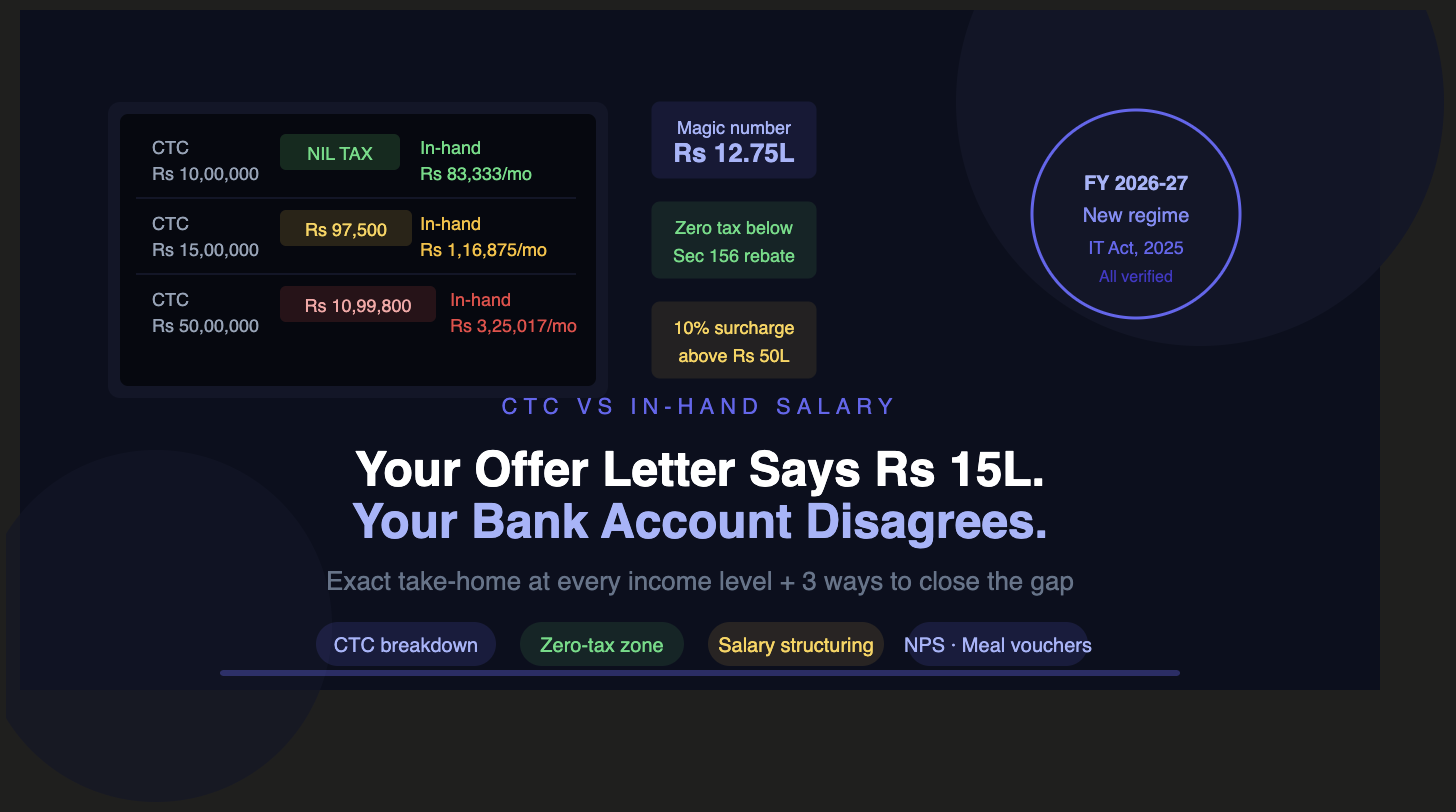
You accept a job offer of Rs 15 lakh CTC. Your first salary credit is Rs 1,16,875. That gap — nearly Rs 8,000 a month — isn't a mistake. It's taxes, and understanding exactly where it goes is the first step to getting more of your own money back.
Under the Income-Tax Act, 2025, the new tax regime under Section 202 is the default framework for all salaried employees. It's simpler, but it has real consequences for your take-home pay — and one very powerful magic number.
The magic number: Rs 12.75 lakh CTC
Here's the single most important thing salaried employees need to know about the new regime: a flat standard deduction of Rs 75,000 is available under Section 19(1). This means that if your CTC is Rs 12,75,000 or below, your taxable income is Rs 12,00,000 or less — and Section 156(2)(a) wipes out 100% of the tax through a rebate of up to Rs 60,000.
In other words, a salary of up to Rs 12.75 lakh CTC results in zero income tax. Your entire CTC minus only your EPF and professional tax (if applicable) is your take-home. That is a genuinely generous zone, and the new regime deserves credit for it.
Your actual take-home at each income level (FY 2026-27)
All calculations below are under the new tax regime with the Rs 75,000 standard deduction applied. Tax figures include 4% Health and Education Cess. The model assumes CTC equals gross salary for simplicity — actual take-home may vary slightly due to EPF and professional tax deductions at your employer.
| Annual CTC | Taxable income | Annual tax (incl. cess) | Monthly tax | Monthly in-hand |
| Rs 10,00,000 | Rs 9,25,000 | NIL (rebate) | Rs 0 | Rs 83,333 |
| Rs 12,75,000 | Rs 12,00,000 | NIL (rebate) | Rs 0 | Rs 1,06,250 |
| Rs 15,00,000 | Rs 14,25,000 | Rs 97,500 | Rs 8,125 | Rs 1,16,875 |
| Rs 25,00,000 | Rs 24,25,000 | Rs 3,19,800 | Rs 26,650 | Rs 1,81,683 |
| Rs 50,00,000 | Rs 49,25,000 | Rs 10,99,800 | Rs 91,650 | Rs 3,25,017 |
Note: For income above Rs 50 lakh, a 10% surcharge applies on the computed income tax. At Rs 75 lakh CTC, the annual tax rises to approximately Rs 20.68 lakh; at Rs 1 crore, to approximately Rs 29.26 lakh.
The pattern is clear: the first Rs 12.75 lakh of CTC is virtually tax-free. After that, every rupee of salary increase carries real tax cost — and at Rs 25 lakh and above, it's significant enough to warrant active planning.
Why does the gap get so large above Rs 15 lakh?
The slab structure explains it cleanly. Under Section 202(1):
- Up to Rs 4 lakh: nil
- Rs 4 lakh to Rs 8 lakh: 5% — maximum Rs 20,000
- Rs 8 lakh to Rs 12 lakh: 10% — maximum Rs 40,000
- Rs 12 lakh to Rs 16 lakh: 15%
- Rs 16 lakh to Rs 20 lakh: 20%
- Rs 20 lakh to Rs 24 lakh: 25%
- Above Rs 24 lakh: 30%
At Rs 25 lakh CTC (taxable income Rs 24.25 lakh), you're paying the full 30% on the top slice. That's why the tax jumps to Rs 3.19 lakh annually — over Rs 26,000 every month. And this is before the 10% surcharge kicks in above Rs 50 lakh of income.
How to close the gap: 3 ways to increase your take-home without increasing your CTC
Because the new tax regime removes traditional deductions like HRA, Section 80C (PPF, ELSS), and home loan interest on self-occupied property, you have to work smarter with what remains.
- The employer NPS 14% move — Section 124(2)
This is the most powerful lever left in the new regime for salaried employees. Under Section 124(2), if your employer contributes to your NPS account, that contribution — up to 14% of your basic salary — is deducted from your taxable income entirely. It doesn't reduce your CTC; it just changes its structure.
For an employee with a basic salary of Rs 8 lakh, 14% equals Rs 1,12,000 in employer NPS contribution. At a 20% tax slab, that shields Rs 22,400 in annual tax — effectively raising your monthly in-hand by nearly Rs 1,900 without any change to your CTC. At the 30% slab the savings are even larger. The key step: ask your HR or payroll team to restructure your CTC to include this. Many companies offer this by default; many don't unless you request it.
- Tax-free meal vouchers — Rule 15(5)(a)
As per the new Income-tax Rules, 2026, effective from 1 April 2026, meal vouchers up to Rs 200 per meal are not taxable under both the old and new tax regimes. This benefit applies for Tax Year 2026-27 onwards. Previously, meal vouchers were not tax-free under the new tax regime.
This is a genuine new benefit for FY 2026-27. The Rs 200 meal voucher exemption is now explicitly allowed under both regimes starting FY 2026-27, under Rule 15(5)(a) of the Income-tax Rules, 2026, effective from 1 April 2026. At two meals per day on approximately 22 working days a month, the annual tax-free value can reach up to Rs 1,05,600. Ask your HR to restructure a portion of your salary as digital meal vouchers (Sodexo, Pluxee, or similar) usable only at eating joints. These must be employer-issued, non-transferable, and used for food and non-alcoholic beverages only.
- Tax-efficient perquisites: broadband, phone, and company car
Several corporate perquisites are taxed far more favourably than cash salary. A broadband or telephone reimbursement for official use is taxable only on the personal-use portion — keeping documented bills ensures the majority is treated as a business expense. Professional development and book allowances, when supported by bills, are similarly efficient. For senior employees, a company car provided by the employer is valued under Table II perquisite rules — typically at Rs 2,400–Rs 3,300 per month for smaller cars — rather than at the full market value of the benefit. Each of these components can meaningfully reduce your tax liability without reducing the real value of your compensation.
The regime choice question: new vs old
For the vast majority of salaried employees under Rs 15 lakh CTC, the new regime wins simply because of the Rs 12.75 lakh zero-tax threshold and lower slab rates. For employees with very large home loan interest payments, significant HRA benefits, or substantial 80C investments already in place, the old regime may still be worth calculating. The right test is always to compute your actual tax under both regimes for your specific number — not to follow a general rule.
The bottom line
Your CTC is what the company pays. Your in-hand is what you actually live on. The gap is determined by the tax slab you're in, the cess, and for high earners, surcharge. But it's also partially within your control — through employer NPS structuring, meal vouchers (now available in the new regime from FY 2026-27), and efficient use of perquisites.
Understanding your payslip in this level of detail takes about 20 minutes. The money you save from acting on it lasts a lifetime.
Need help calculating your exact take-home or restructuring your salary for maximum in-hand? Reach out to Virtualca Services — we'll run the numbers for your specific CTC.

Comments