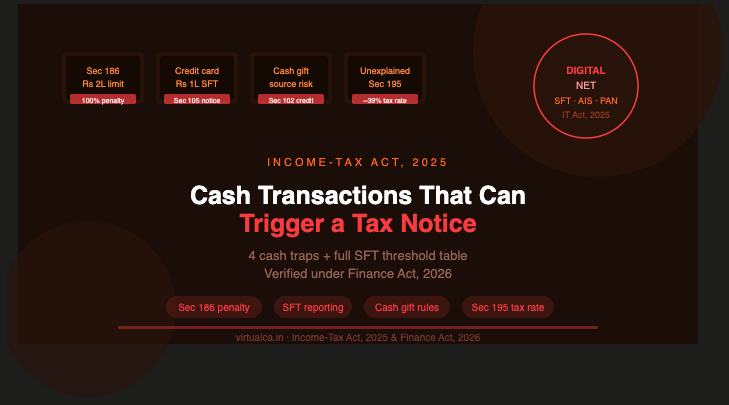
Cash Transactions That Can Trigger an Income Tax Notice — And How to Avoid Them
Cash feels private. You hand over notes, the deal is done, no app notification, no bank entry. It feels off the record.
It isn't. Under the Income-Tax Act, 2025, the government has built a sophisticated digital surveillance net — a web of mandatory reporting by banks, registrars, card companies, and financial institutions — that makes large cash movements highly visible. Worse, if you can't explain where the money came from, the tax treatment is punishing even after the Finance Act, 2026 brought some relief.
Here are the four most dangerous cash traps, followed by the complete SFT reporting threshold table every taxpayer should know.
Trap 1: The Rs 2 lakh barrier — Section 186
This is the most fundamental cash rule in the Act and the one most often broken accidentally.
Section 186 of the Income-Tax Act, 2025 prohibits any person from receiving Rs 2,00,000 or more in cash in three situations: in aggregate from a single person in a day, in respect of a single transaction, or in respect of transactions relating to one event or occasion.
This is not just a rule for businesses. It applies to everyone. Sell a piece of ancestral jewellery for Rs 2.5 lakh and accept cash? You've violated Section 186. Accept Rs 2 lakh from a relative for a wedding expense, all in cash? Same violation — regardless of the fact that the money is from a family member.
The penalty under Section 451 is unambiguous: it equals 100% of the amount received in violation. On a Rs 2.5 lakh sale, you would owe the government Rs 2.5 lakh as penalty — effectively surrendering the entire value of your transaction.
Importantly, Section 186(2) carves out exemptions for the government, banking companies, post office savings banks, and co-operative banks. For everyone else, the rule applies in full.
Trap 2: Paying credit card bills in cash — SFT Rule 237
Many people believe that paying a credit card bill in cash is a way to keep spending "off the books." The card was already used; surely the cash payment is just clearing a debt?
The Income Tax Department sees it differently. Credit card companies and banks are designated "Reporting Entities" under the Statement of Financial Transaction framework. Under Rule 237 (reported via Form 165), if you pay Rs 1,00,000 or more in cash against credit card bills in a single financial year, your bank is legally required to report this directly to the Income Tax Department.
These transactions are routinely flagged under the Statement of Financial Transactions filed by financial institutions, enabling tax authorities to detect discrepancies between spending and declared income.
The department then cross-references this cash payment against your ITR. If your declared income is Rs 5 lakh but Rs 2 lakh of it was paid in cash to a credit card company, the gap becomes visible. A notice under Section 105 for Unexplained Expenditure follows — asking you to explain the source of that cash.
Trap 3: Accepting large family gifts in cash — Section 92
Most people know that gifts received from "relatives" are tax-free. Under Section 92(3)(a) of the Income-Tax Act, 2025, money received from a relative — which includes spouse, parents, siblings, and lineal ascendants and descendants under Section 92(5)(g) — is fully exempt from tax regardless of the amount.
What most people don't know is that "exempt" and "unquestionable" are not the same thing.
If you receive Rs 5 lakh in cash from your father for a house down payment, the exemption technically applies. But the Assessing Officer can still ask you to prove the "source of the source" — where your father got that cash. If he cannot demonstrate a banking trail showing the withdrawal, the amount may be reclassified as an Unexplained Credit under Section 102, taxable in your hands.
SFT reporting creates a web of cross-reported financial data. For honest taxpayers it is mostly a non-issue. For those who underreport, it significantly raises the chances of detection.
A gift deed or affidavit alone is increasingly treated as self-serving evidence if not backed by a banking entry. Section 185 makes this even clearer for loans: any loan or deposit of Rs 20,000 or more taken in cash is prohibited. The right approach — always — is to transfer family money via NEFT, RTGS, or cheque, and execute a gift deed that references the specific bank transaction ID and the donor's PAN.
Trap 4: The "unexplained" money problem — Sections 102, 105 and 195
When a cash transaction is flagged and you cannot provide a satisfactory explanation, two sections deliver the consequence:
Section 102 covers Unexplained Credits — any sum found credited in your books or bank account for which you have no satisfactory explanation of its nature and source. Section 105 covers Unexplained Expenditure — any money spent for which you cannot explain where it came from.
Under Section 195, such amounts are taxed as income at a special rate. The Finance Act, 2026 (effective 1 April 2026) reduced the base rate from 60% to 30%. While this reduction appears at first glance to dilute the rigour of the existing regime, the simultaneous strengthening of penalty provisions ensures the overall framework remains stringent — introducing a differentiated approach that is lenient for voluntary disclosure but significantly harsher upon detection.
The current effective rate works out to approximately 39%: 30% base tax, plus a 25% surcharge on that tax, plus 4% health and education cess. No deductions, no set-offs, no expense claims are permitted against this income. Critically, the rate reduction to 30% applies under Section 195 of the Income-Tax Act, 2025 as substituted by Act No. 4 of 2026 with effect from 1 April 2026.
On a Rs 10 lakh unexplained cash amount, the tax liability at 39% effective rate would be approximately Rs 3,90,000 — nearly four lakh rupees on money you may have already spent.
Bonus: The complete SFT reporting threshold table
This is what the government already knows about your finances before you even file your ITR. Every entry below is automatically reported to the Income Tax Department and reflected in your Annual Information Statement (AIS).
Financial entities must report the following transactions under Statement of Financial Transactions rules:
| Transaction type | Reporting threshold | Reported by |
| Cash deposits — savings account | Rs 10 lakh or more in a year | Bank |
| Cash deposits — current account | Rs 50 lakh or more in a year | Bank |
| Fixed deposit opening (cash) | Rs 10 lakh or more | Bank / post office |
| Credit card payment (cash) | Rs 1 lakh or more in a year | Card company / bank |
| Credit card payment (non-cash) | Rs 10 lakh or more in a year | Card company / bank |
| Purchase / sale of property | Rs 30 lakh or more | Property registrar |
| Mutual fund investment | Rs 10 lakh or more in a year | Mutual fund house |
| Shares / bonds / debentures | Rs 10 lakh or more in a year | Broker / company |
| Foreign exchange purchase | Rs 10 lakh or more in a year | Authorised dealer |
| Stamp paper purchase | Rs 2 lakh or more | SHCIL / stamp vendor |
From April 2026, the SFT framework has expanded — stamp paper purchases are now tracked, crypto-asset transaction statements are mandated, and insurance reporting thresholds have been lowered. If any of these transactions show up in your AIS and don't match your ITR, expect a mismatch notice.
Best practices: how to stay invisible to the taxman (legitimately)
The goal is not to hide transactions — it is to ensure every transaction can be explained. Four practical rules:
Use digital modes for all family transfers above Rs 20,000 — NEFT, RTGS, UPI, or cheque. Execute a gift deed for large family transfers referencing the donor's PAN and the bank transaction ID. Keep a copy of the donor's bank statement showing the withdrawal — this proves the "source of the source." Never pay credit card bills, insurance premiums above Rs 50,000, or business expenses in cash if you want to avoid routine SFT scrutiny.
The bottom line
Some taxpayers assume that non-disclosure in an ITR allows transactions to go unnoticed. This is no longer the case — high-value activities including cash deposits, property purchases, and mutual fund investments are now automatically reported to the Income Tax Department via the Statement of Financial Transactions.
Cash is not private money under the Income-Tax Act, 2025. Every large cash movement leaves a digital footprint in someone else's SFT filing — your bank, your card company, your property registrar. The only protection is a clean paper trail, banking-mode transactions, and an ITR that matches what the department already knows.
Need help reviewing your AIS for mismatches or planning large transactions correctly? Reach out to Virtualca Services — we'll make sure every rupee you move is fully defensible.

Comments